
Quick answer
How Much Is an Old Shell Gas Station Sign Worth?
An old Shell sign’s value starts with the exact design. Identify whether you have a pump plate, shaped shell, or larger station sign, then match size, material, and condition.
Distinguishing Shell formats
Read the layout before pricing the logo. A small branded pump plate served a different purpose from a large shaped sign at a station, and a sale of one is generally a weak price comparison for the other.
Photograph the margins, any brand wording or maker’s marks, and the original-looking holes. Measure the broadest point and the overall height of an irregular shape rather than estimating from the photo.
Turn attention to the back and the mounting edge. Where both faces exist, photograph each one and describe which was exposed outdoors. Include any original frame separately.
Give the sign its own record before you put a price on it. For Shell gas station, write down the full wording and the condition of the parts you can see. Label each observation as something you saw, something a previous owner told you, or something you found in a dated source. When you get a possible match, that record makes it easier to see which details agree and which ones still need an explanation.
Compare like-for-like sales
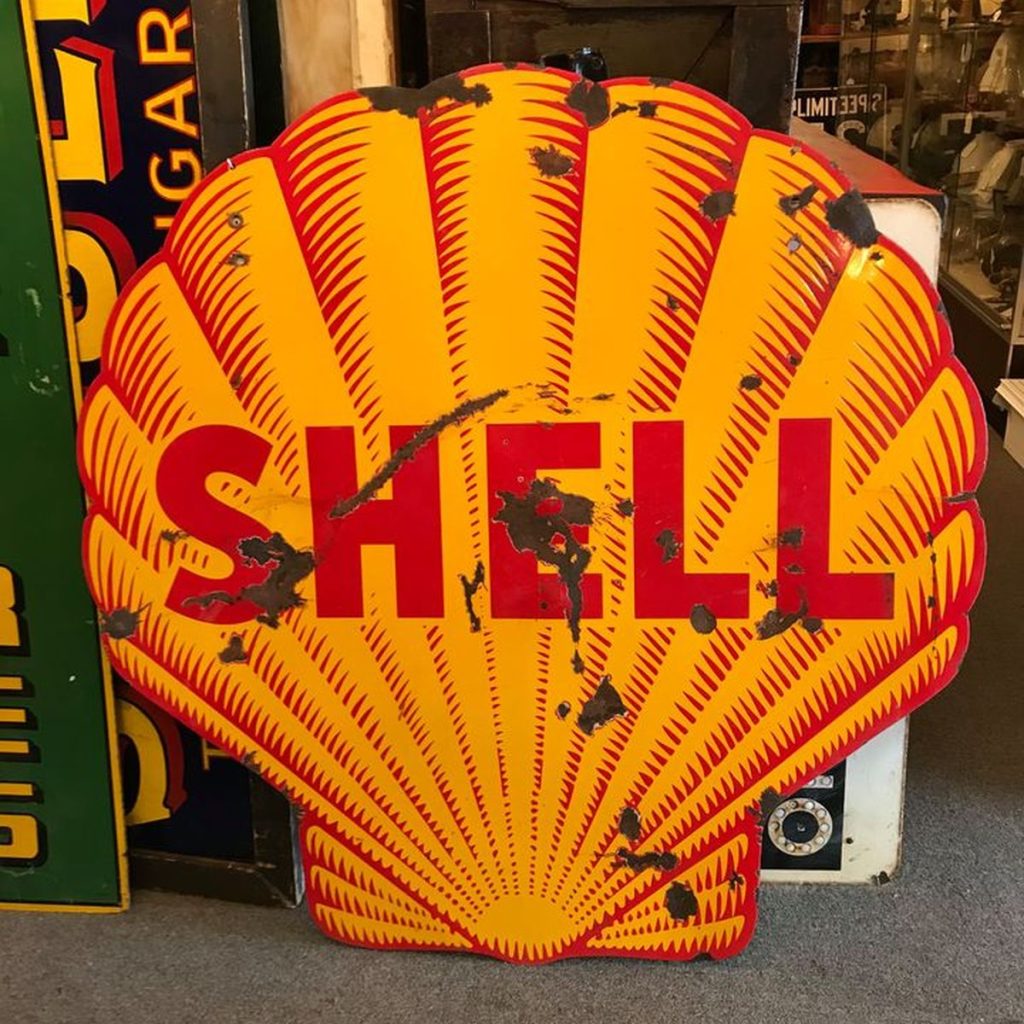
Start with a completed sale that matches the piece closely. If you have a shaped yellow-and-red Shell sign with a worn mounting edge, make a side-by-side note with the dimensions, number of visible faces or pieces, mounting method, and condition. For signs sold as part of a group, check whether a price was assigned to the individual piece. Keep the sale date and the link so you can revisit the comparison.
Read how the price is reported before you compare two results. A winning bid, a price including buyer’s premium, and the amount the seller receives describe different parts of a transaction. If the sales do not say which figure is shown, record that as unknown. For a direct purchase, confirm which pieces and services are included in the offer, such as collection from a specific location.
If you find only one promising comparison, list the most important difference in a sentence. A damaged face, a missing ring, a different scale, or an unverified date can make a sale less useful for pricing. A documented difference is more helpful than applying an arbitrary discount. Keep one or two references to send Tom with your photos if they clarify what you own.
A seller’s example
Imagine an owner finds a shaped yellow-and-red Shell sign with a worn mounting edge. They want to know what they have and decide whether to sell, so they save a few reference photos and measure their piece first. The owner finds an expensive Shell Ethyl result, then notices it depicts a different format. They measure their shaped sign and use the overall design and mounting details to look for a better match.
The owner keeps the original photos and the messages about the sign together. Before deciding, they confirm what the buyer has seen, what is included, and when payment and pickup would happen. If a family member has a different recollection about the piece’s age or origin, they include that uncertainty in the description. This example is illustrative.
What to send Tom
- Photograph the margins, any brand wording or maker’s marks, and the original-looking holes. Measure the broadest point and the overall height of an irregular shape rather than estimating from the photo.
- One straight-on photo of each accessible face. Include a wide shot that shows the whole piece.
- Height and width, with the face and frame measured separately when applicable.
- Close-ups of any maker’s line, mounting holes, damage, and known repairs.
- Your city, whether you are selling one item or a collection, and any timing or pickup constraints.
Frequently asked questions
Does the Shell logo tell me the age?
Compare the shape, wording, construction and marks with dated examples. Logos can be repeated on later pieces.
Are pump plates comparable to large Shell signs?
Look for another example of the same format and similar dimensions.
What if one side is more faded?
Photograph both faces in even light and make the difference clear in the description.
What photos should I text Tom first?
Begin with the full face of a shaped yellow-and-red Shell sign with a worn mounting edge. Add the reverse, dimensions, and one close-up of markings or damage. If you have multiple pieces, give each one a number and keep the corresponding photos together.
Can I ask for an offer if I don’t know the year?
Yes. Tell Tom what you know about the piece and where it was found. Antique Sign Guy focuses on signs made before 1970. Clear views of the construction and maker’s print can help him decide whether your sign fits.
Is the highest auction result a reasonable asking price?
Start with completed sales closest to your sign in construction, size, and condition. An exceptional result can show what makes a particular example special. Check what the number includes and how closely the piece matches yours.
How do I sell directly to Tom?
Text 916-817-9625 with photos, your city, and the approximate size. Say that you’re looking to sell. If there is a fit, ask which pieces the offer covers and confirm payment and pickup terms before accepting.
What if my photos show damage or old repairs?
Include them. A wide photo shows how the piece displays, and a close-up lets someone see the scope of the wear. Mention any known repainting, replacement parts, cracks, or extra holes. That helps Tom make an offer with fewer unknowns.
Ask Tom for a direct purchase offer
Have a sign you think was made before 1970? Text Tom at 916-817-9625 with photos, approximate dimensions, and your city. If the sign is still mounted or you’re clearing an estate, say so up front. Tell Tom you’d like to sell so he can review it as a possible purchase.
Related guide and auction reference
Read a related Antique Sign Guy guide for more help identifying or documenting your piece.
Richmond highlighted a rare Shell Ethyl Eight Ball porcelain pump plate at $161,000. That is a specific variant. The shaped Shell sign pictured here illustrates a different format. Richmond’s Shell Ethyl Eight Ball lot.

