
Quick answer
Which vintage Hamm’s beer signs are worth getting appraised?
Get a closer look at Hamm’s neon signs and lighted or motion displays with their original cases, artwork, and parts. Identify whether yours is neon, a stationary lighted display, or a motion sign before comparing completed sales.
Identify the design, condition and completeness of a vintage Hamm’s motion or lighted beer sign before comparing sold prices.
Identify the display
Write down the full wording and photograph the scene. Note whether you have a lighted panel, a motion display, or a stationary piece. If it has a case, photograph all sides and the back label. The design and the mechanism both matter when you look for a matching sale.
Look for missing or replaced pieces
Inspect the outside for cracks, brittle corners, holes, and discoloration. Record any missing trim, cracked panels, or replacement parts you know about. If the sign is already known to run safely, a short video can show both the lighting and the movement. Leave an untested unit unplugged.
Compare like with like
A working example with its original case is a poor price comparison for a loose panel or a unit with a stalled mechanism. Search by the exact wording and dimensions, then use completed sales of similarly complete examples. Keep a front and back photo ready if a listing leaves you unsure whether the match is close.
Make a photo record a buyer can use
For a Hamm’s motion or lighted display, make a short record while everything is still in front of you. Start with the entire scene, case corners, rear label, mounting points, and dimensions. Include the exact slogan, what moves or lights, and which pieces are present. One way to keep everything straight is to capture photos of the face both close up and from far enough away to show the whole case. Preserve each image at its original size. Wide shots establish context, and close-ups let someone zoom in on the details that are too small to read in the wide shot.
If you have more than one piece, give each one a simple number and use it in the photo filenames or in your message. Keep any paperwork with the matching item. Be especially clear about faded scenery, cracked covers, missing trim, and replaced mechanisms. Write down who told you the history and when, and mark dates or attributions you’re unsure about. That gives a buyer something specific to follow up on when a photo raises a question.
When several pieces are involved, a single message can introduce the collection and list the items you’re ready to sell. Follow it with the clearest photos of the most promising piece. You can send additional details as requested. If timing matters, mention when you need a decision and whether the items have to be moved by that date. An early conversation is easier if the owner can still check a measurement or photograph a label.
Compare completed sales before choosing a price
Start with the exact kind of item you have. In this category, you might encounter a moving scene, a stationary lighted panel, and a loose face from a larger sign. Those are separate starting points for research. For each plausible match, write down its measurements, material, condition, sale date, and any detail that explains a difference from your example. Keep the link and a note about where the price came from, so you can revisit the comparison later.
Ask whether the number represents a completed sale, an active listing, or an estimate. In an auction result, check whether the figure is the winning bid alone or includes the buyer’s premium. If you’re deciding whether to sell, consider what you would receive after fees, packing, and transport. Keep prices in their original units and use the actual sale date when comparing older results with recent ones.
When the closest match has an important difference, write it in plain language. It might be a smaller example, a different mounting style, or an unusually complete piece. Avoid applying a fixed discount without evidence. Two or three imperfect matches can still help a buyer explain a range if the differences are visible. If the sale history is thin, the photos and ownership history become especially useful.
Describe the scene separately from the mechanism
Take a photo that shows all the artwork at once. Then record whether you know the light and motion ever worked, when someone last saw them operate, and whether the unit was serviced. An exterior label or old repair receipt can narrow down what you have. The artwork may help identify the display even when its operating condition is unknown. A buyer can then assess two questions separately, how closely the case and artwork match a documented model and how much uncertainty remains about its condition.
An example from a seller’s point of view
Here’s a hypothetical example. A family finds a scenic Hamm’s display with a cracked corner and is unsure whether the original moving parts are still inside. At first, the seller has enough information to start looking online but still has several details to confirm. Rather than relying on the first result, they measure the case, photograph the exterior label, and disclose that the unit has sat unplugged for years. The payoff is practical. An evaluator can compare the same model and distinguish cosmetic damage from unknown operating condition.
One online example shows the same beer name but a different arrangement of artwork and trim. The family notes the number of visible panels and whether the border is intact. They include a close-up of the cracked corner so a buyer can assess what would need repair and whether matching parts might be hard to find.
What to photograph for an appraisal
- Show the complete Hamm’s display, including the artwork, case or tubing, and trim.
- Take straight-on photos of the front and back where you can reach them safely.
- Add close-ups of the edges, mounting holes, marks, and any damage or repairs.
- Send dimensions, your location, and any history you can document.
What the featured Hamm’s photo shows
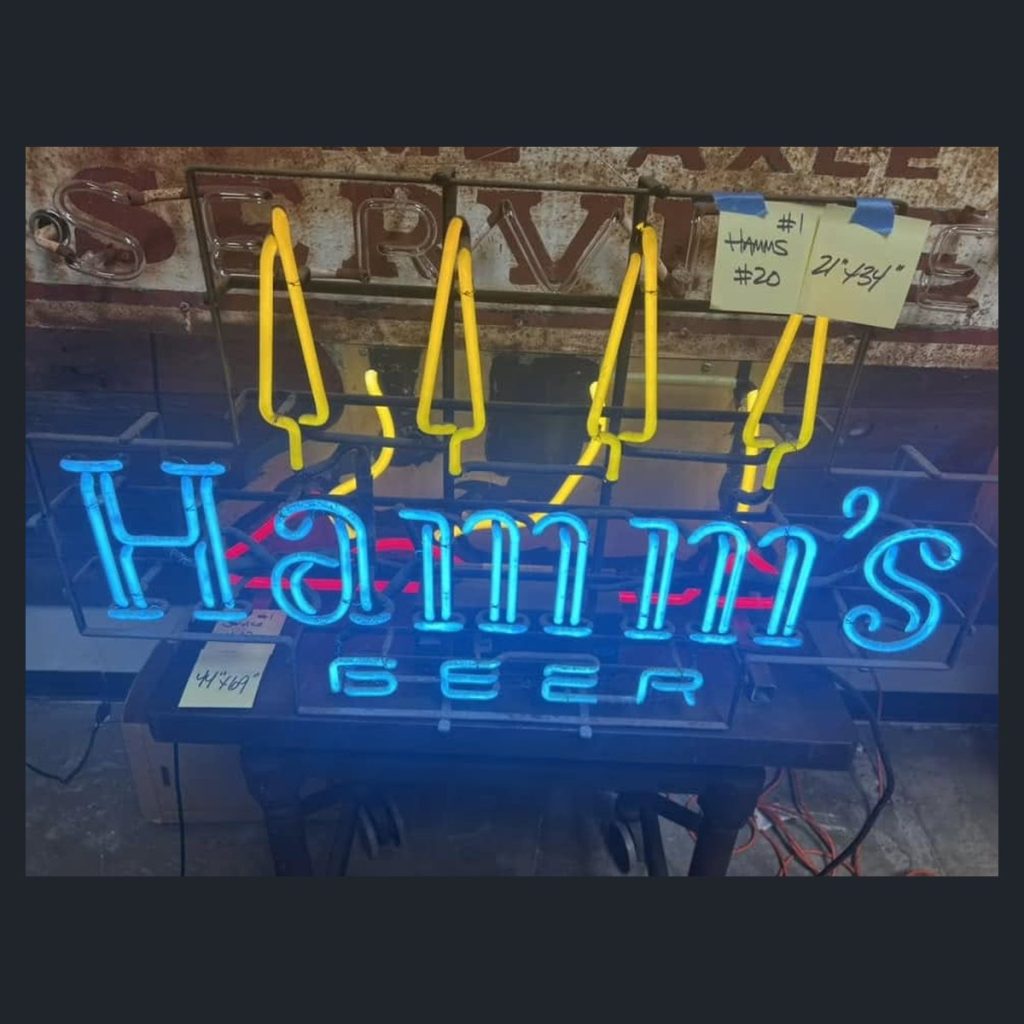
The featured photo shows blue Hamm’s Beer lettering with yellow and red neon accents. Use that view to record the tubing layout and locate the frame. For an appraisal, add an exterior label photo and your own measurements. If your Hamm’s sign instead has a scenic panel or motion mechanism, look for comparable sales of that type.
Frequently asked questions
Can I estimate a loose Hamm’s panel using a sale of a complete display?
A complete sale helps identify the design. Look for separate panel sales to estimate what the loose piece may bring.
What if it lights up but the scene doesn’t move?
Record the two observations separately. Buyers may compare it with partially working examples rather than fully working units.
Do I need to open the housing for a photo?
Exterior views and readable labels are a good starting point. Have a qualified specialist inspect the interior if needed.
What should I include when I ask for an appraisal?
Start with the entire scene, case corners, rear label, mounting points, and dimensions. In your message, include the exact slogan, what moves or lights, and which pieces are present. State where the piece is and whether you’re looking for a valuation, interested in selling, or both. For multiple pieces, start with an overview so we can tell which photos go together.
Can I get a useful estimate from one photo?
A front photo is enough to start the conversation. A buyer may need the back, dimensions, markings, and condition details before giving a meaningful estimate. If you can get only one view safely, send it and explain where the sign is mounted or stored.
Is a Hamm’s neon sign comparable to a motion sign?
Compare each with its own type. The construction, parts, and collector demand can differ even when the brand is the same.
What if I see two handwritten sizes on the display?
Measure your sign directly and photograph the tape or ruler in place. Record the outside frame dimensions separately from the face.
Can the artwork identify a display with no label?
It can narrow the search. Compare the scene, wording, trim, and case dimensions with documented examples.
Get a vintage sign appraisal
If you think your sign was made before 1970, text photos of both sides, close-ups of markings, and dimensions to 916-817-9625. See how to get your sign appraised.
